


Feeler Gauge - 32 Blades KD10561 KRAFT&DELE

Key information
Availability:Temporarily out of stock — ask for availability
Shipping cost:From 3.29 Euro
catalog number:KD10561
Availability:
EAN code:5903957000794
Product condition:New, originally packaged
Guarantee:24 months of consumer protection
Weight:0,13 kg
By purchasing this product, you will receive 22 points from us, which you can use for shopping in our store. This applies only to customers registered in our store.
- Product description
- Product reviews (0)
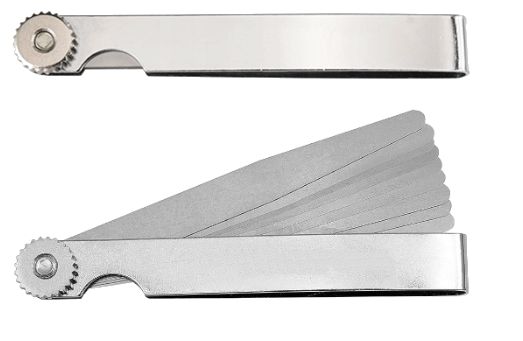
Feeler Gauge 32 Blades — Kraft&Dele KD10561
The KD10561 feeler gauge is a measuring tool used to determine the size of gaps and clearances between mating mechanical components. The set of 32 stainless steel blades covers a range from 0.03 to 1.00 mm, allowing precise measurement of clearances in combustion engines and other mechanical assemblies.
Tool features
Stainless steel
Blades made from stainless steel resist corrosion and the effects of engine oil. The material ensures the tool's durability and the dimensional stability of the blades over many years of workshop use.
Wide measuring range
The range from 0.03 to 1.00 mm, with 32 intermediate values, allows measurement of both very small valve clearances and larger gaps in mechanical assemblies. Blades can be combined to obtain intermediate values.
Blade dimensions 100 × 10 mm
The 100 mm length allows the blade to be inserted easily into hard-to-reach places, such as between a valve seat and valve stem. The 10 mm width provides a comfortable grip and stable contact with the surfaces being measured.
Clear markings
Each blade has its thickness in millimetres etched or permanently printed onto it. The markings do not wear off during normal use, which eliminates the risk of confusing blades of similar thickness.
Technical specification
| Model | KD10561 |
| Brand | Kraft&Dele |
| Number of blades | 32 |
| Measuring range | 0.03 – 1.00 mm |
| Blade length | 100 mm |
| Blade width | 10 mm |
| Material | Stainless steel |
| Available thicknesses (mm) | 0.03 / 0.04 / 0.05 / 0.06 / 0.08 / 0.10 / 0.13 / 0.15 / 0.18 / 0.20 / 0.23 / 0.25 / 0.28 / 0.30 / 0.33 / 0.35 / 0.38 / 0.40 / 0.45 / 0.50 / 0.55 / 0.60 / 0.63 / 0.65 / 0.70 / 0.75 / 0.80 / 0.85 / 0.90 / 1.00 |
Applications
A feeler gauge is used wherever clearance between two surfaces needs to be checked. The most common applications include:
- Measuring valve clearance in petrol and diesel engines
- Setting spark plug electrode gaps
- Checking piston-to-cylinder clearance
- Checking bearing and bearing shell clearance
- Measuring clearance in brake systems
- Checking for distortion and surface flatness
- Setting clearances in industrial and machine tool machinery
- Assembly measurements when putting together mechanical components
Usage
How to use a feeler gauge correctly
A blade of the correct thickness should slide into the gap with a noticeable but light resistance — without snagging and without looseness. If a blade slides in freely, the gap is larger than its thickness; if it will not go in at all, choose a thinner blade. To obtain intermediate values, several blades can be combined by adding their thicknesses together. Before measuring, clean oil and contamination from the surfaces to be measured, as these could distort the result. After use, wipe the blades and fold them back together to prevent deformation.
Commercial information
Nobody has written a review for this product yet. Be the first to write a review.
Write a review for this product and you will receive 100 points from us that you can use for shopping in our store. This applies only to customers logged in and registered in our store.
Only registered customers can write product reviews. If you have an account in our store, log in to it, if not, create a free account and write a review.
